
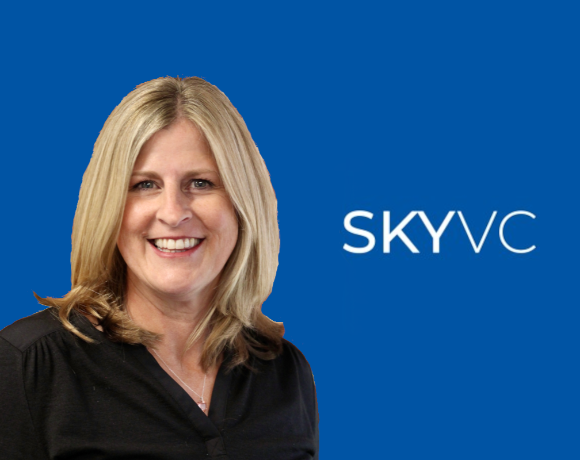
After its acquisition by SKY Leasing in 2025 and later rebrand from JetBlue Airways’ corporate venture arm, SKY VC, formerly JetBlue Ventures, is seeking to combine early-stage technology investing with a broader network of travel and transportation partners.
Ishka SAVi sat down with Amy Burr, CEO of SKY VC, on the sidelines of the Ishka AirFinance Horizon conference to discuss how the firm is positioning itself after its acquisition by the San Francisco-based asset manager, why it has backed hybrid-electric regional aircraft developer EVIO, and where SAF and other sustainability technologies fit within its wider early-stage mandate.
A wider platform, not a clean break from JetBlue
The rebrand from JetBlue Ventures to SKY VC in September 2025 shifted the platform away from an airline branded identity, but Burr tells Ishka that the same team, thesis, and operator expertise that defined JetBlue Ventures' reputation carry directly into SKY VC. “Our team is still partnering with those same portfolio companies and has a similar mindset about investing,” Burr explains. SKY VC remains focused on early-stage start-ups and on how their technology can solve “actual problems in an operating company of some sort, an airport, an MRO, an airline.”
To that end, SKY Leasing brings its aviation asset-management experience, market relationships, and financing insights around how new technologies could eventually fit into the market. Burr points to eVTOLs, hybrid-electric aircraft, and other electrified aviation equipment as examples of businesses with “people who might want to get into the leasing space”.
JetBlue remains a strategic partner, and the team continues to manage early investments with ongoing participation by the airline, but “the way we’re thinking about it is we are going to have a whole host of partners beyond JetBlue.” New partners are expected to join, sitting across the travel and transportation ecosystem, including other “international airlines.” Burr says SKY VC is already in conversations across the UK, Europe, Asia, and some emerging markets.
The interest by potential new partners has so far been global, but not evenly distributed. Burr says that the strongest conversations have been with companies that already understand the need to track emerging technology, and those with internal innovation teams who “want to know all the time what is the very next thing”.
SAF and sustainability: “something new and different”
SKY VC’s sustainability allocation commitments will be more selective than during its previous tenure as JetBlue Ventures, when early climate-tech investments were deliberately spread across several categories – including propulsion, electrification, SAF, carbon offsetting, direct air capture, and software. “We needed to help fund the development of this entire category of technologies so that we would know over time who the winners ultimately are,” Burr explains. “Now, we’ll be more selective about the type of technology we’re going to invest in within the sustainability category.”
On SAF, SKY VC has backed Aether Fuels and AIRCO, formerly Air Company, but the firm is not looking to finance another standard pathway. It wants “something new and different” and to “fund the next generation”. Looking ahead, she said SKY VC evaluates SAF investments through two lenses: whether the company is changing the way an existing technology works to make it cheaper or more efficient, or whether it's using a new feedstock or is "feedstock-agnostic."
Feedstock availability has emerged as one of the most salient bottlenecks for the SAF scale up, and Burr says future opportunities could therefore sit in “parts of the value chain” rather than in SAF production itself. She points to DAC firm Avnos, which captures carbon and packages it as a potential SAF feedstock, as one example.
The firm still includes sustainability in its investment thesis, but Burr places it within a wider frontier technology mandate. SKY VC has also made around 17 AI investments, and Burr says the firm is better described as an “early-stage enterprise and frontier technology investor” than a sustainability fund.
New propulsion involvement
Burr says the firm invested in around 12 sustainability or climate-tech companies during its previous ownership and “placed a number of bets” across the decarbonisation spectrum. Among them is its investment in EVIO, a Boeing-backed hybrid-electric regional aircraft start-up that emerged from stealth mode last December.
The OEM aligns with the fund’s view on new propulsion CTOL aircraft, which is that hybrid-electric will be more commercially compelling than all-battery. “Our thesis has long been that electric hybrid is going to be more impactful than just a [pure] electric aircraft,” she explains, pointing to the latter’s “shorter range” and therefore “smaller market”. On perspectives for the industry, Burr comments that while “a lot of the winning e-VTOL companies have been well-funded over the course of time,” – Sky VC invested in e-VTOL Joby Aviation in 2017 and the company went public in 2021 – she expects that balance to shift as CTOL companies hit their milestones, with the sector eventually “catching up” and becoming “more interesting to investors.”
On certification – which has become a major focus for the new propulsion investors as a whole – Burr explains that as an early-stage investor interested in frontier technologies, SKY VC investments can see long lead times between investment and going to market. As a result, the fund wants to see companies with “really good relationships with whatever certification body they’re using”, warning that the certification path can lengthen quickly without early regulatory engagement. Her view is partly shaped by her own experience as a founder of Virgin America, a low-cost airline acquired by Alaska Air Group in 2016, where she worked with the FAA and Department of Transportation during the airline’s launch. The FAA process to obtain an air operator’s certificate (AOC), she said, is “incredibly long” and detailed. “If you’re not paying attention and you’re not building that relationship right away, it can be a very challenging process to get through.”