
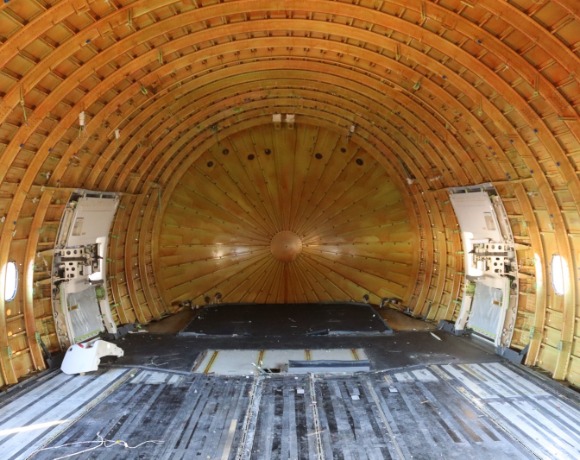
Aircraft boneyards, while they still exist, are no longer representative of aircraft disposal today. At the end of their economic lives, aircraft are mostly recycled, reaching a small but meaningful environmental redemption. Their most valuable components are stripped and reconditioned for further use, many airframe materials are recycled, and depending on the aircraft, sections and furnishings may be repurposed as reclaimed items and memorabilia. But despite remarkable progress to reach 80% recyclability or higher, more can still be done.
Today, approximately 20% of aircraft parts fall outside what is recyclable under current practices, using the recyclability formula of Aircraft Fleet Recycling Association (AFRA) – total material weight after reuse and repurpose. This 20% encompasses a range of materials, exotic alloys, and chemicals without an economically viable recycling path – if a recycling method exists at all.
Steady historical improvements in recyclability may give the impression that the remaining 20% will be chipped away with time but, unfortunately, several barriers stand in the way. Materials without an economically viable recycling path today, such as batteries or composites, are used in greater amounts in newer generations of aircraft. Others, like cabin carpets, need to be tackled by breaking industry silos, enabling collaboration to jointly find applicable recycling methods or, if these do not exist, develop them.
This report, informed by non-profit Aethos, outlines the fundamental challenges blocking the path to a fully recyclable aircraft.
‘80% recyclable’
A frequently shared statistic of how much of an aircraft can be recycled comes from Airbus-owned Tarmac Aerosave, a company based in southern France born out of the Airbus-coordinated PAMELA project (Process for Advanced Management of End-of-Life Aircraft) initiated in 2006. According to Tarmac Aerosave, up to 92% of an Airbus A320’s total weight and more than 99% of its CFM engine parts are recycled. More commonly, however, the industry quotes a recyclability range between 80% and 85% for modern aircraft.
In 2024, a joint study by aircraft dismantler Ecube, together with British Airways, Plane Reclaimers, and Celsa Steel UK conducted one of the very first comprehensive assessments of an Airbus A320 disassembly and recycling. The British Airways aircraft, MSN 1424, showed that the theorised 80% recyclability (reuse, repurpose, or recycle) is indeed possible, achieving a measured 83%. Approximately 30% of the aircraft by weight was made up of return to service components (reuse), 13% repurposed as non-airworthy material, and 40% recycled materials. This left 17% of waste for disposal, or roughly 7.5 tonnes.
As noted earlier, recyclability in the 80% ballpark is at present a best-case scenario. For instance, Ecube notes in the study that demand for BA memorabilia “may exceed other airlines,” suggesting repurposed (also known as upcycled) material rates may be lower on other aircraft dismantling projects. The results are also reflective of aluminium airframe aircraft, but latest-generation widebodies made with composite airframes are understood to have, at present, much lower recyclability rates.
Underestimated complexity
Reduce, reuse, and recycle – the three Rs are ingrained in the public mindset of how to manage waste flows. But the word recycle is more complex than most people realise. “Some people say, ‘I'm recycling 100% because I'm giving it to a recycling company.’ Yeah. But how successful will that recycling company be in recycling all the different components and materials?,” comments Derk-Jan van Heerden, who established Aethos as a research-focused foundation in 2023.
Companies in the aircraft dismantling and recycling sectors increasingly use the AFRA-defined recyclability rate when referring to the total amount of recycled material: total material by weight after reuse and repurpose. True success in the recycling industry is a spectrum of process efficiencies, secondary waste minimisation, and material circularity.
For instance, aviation-grade aluminium used in fuselages is often downcycled into lower-value items like bicycle frames and, famously, beverage cans. But “proper recycling is not only about reintroducing a material into the supply chain, it is also about preventing new stuff from being manufactured,” explains Dick Allewelt, who joined Aethos in April this year as the foundation’s first managing director. Thus, a better recycling outcome would be to re-use fuselage aluminium to manufacture new aerospace parts.
“Currently, most of the aircraft aluminium is downcycled because it typically consists of two aluminium alloys attached to each other. This is one of the research projects we're planning to take on: figuring out if it is possible to debond the two in such a way that the cost and the environmental impact of splitting them up is lower than the benefits of having those two alloys separated and ready for reuse,” explains van Heerden, better known to many in the industry as the founder and former CEO of Dutch aircraft dismantler AELS.
Aethos, in partnership with AFRA, recently awarded its inaugural Aircraft Material Recycling Award to a project by French industrial research institute IRT Jules Verne that developed a specialised dismantling robot. Equipped with a precision saw, the robot is designed to cut aircraft structures in ways that preserve the integrity of individual material streams – making it easier to isolate components and prevent aluminium from being unnecessarily downcycled.
Not all waste streams are created equally
Viable recycling options for an aircraft dismantler hinge on more than just an airline or lessor customer’s willingness to pay. Some advanced materials in aircraft like composites or exotic alloys are too complex and relatively low volume for the recycling industry to develop commercially viable processes. A further complication is the lack of predictable waste streams in aircraft recycling. The swings of aircraft part-outs across aviation industry cycles are well known for dictating the availability of used serviceable material (USM) parts, but they also impact external parties processing materials for recycling.
“From the perspective of the aviation world, it’s a lot of material, but for a recycling company, it’s not. […] In addition, supply is far from constant: a pandemic or a changing market dynamic can disrupt it easily. At the moment, everything that can fly is flying, for instance, due to [OEM] delivery challenges. This means dismantlers lack a steady influx of material, and the quantities are often too small to be viable. Aethos wants to link them, so they can start pooling low-quantity materials in a single place and recycle them,” comments Allewelt.
A further aspect to consider when assessing recycling is the methods used – some are cleaner than others, and safer than others. For instance, Aethos’ first role as part of a project consortium tackles one of those challenges: Project PANTHER, which will study how to recycle painted aircraft scrap safely and sustainably.
Challenging waste streams
Some examples of wastes that aircraft dismantlers struggle to deal with include:
- Carbon Composites – newer aircraft contain a lot more composites, and because of recent market dynamics these relatively young aircraft are already being sent to be dismantled. There is as yet no viable recycling method for these composites.
- GLARE (GLAss REinforced aluminium laminate) – a fibre-metal-laminate used in the Airbus A380 (among others), again a relatively young aircraft model that is being offered to dismantlers prematurely because of a changing market.
- Batteries – although many types of batteries in aviation are already being recycled, there are some types where no viable method is available yet. Regulations also encourage replacing a battery over extending their lifecycle.
- Carpets and seat paddings – respectively made up of complex composites of nylon fibre, wool, as well as layers of foam paired with chemical fire-retardants. These materials are fused together, making separation for pure material recovery technically challenging.
The Ishka View
All waste has an environmental cost (biodiversity impacts, emissions from incineration, loss of material value) and a monetary value. In some cases, the cost of incineration or landfill can be sufficient to motivate an aircraft dismantler to adopt more circular processes. In other cases – often depending on the location of the company as well as the costs and availability of waste disposal or treatment services – it may not, creating a choice for asset owners: to part-out aircraft with a lower overall payout (from profits recouped from serviceable material) possibly in exchange for more cost-intensive higher environmental standards, or to simply take the highest bid tendered.
To help inform that choice, associations like Aethos stand ready to help, offering lessors and asset managers the opportunity to better understand their Scope 3 emissions and environmental impacts related to aircraft disposal. Aethos has the ambition to become a convening point for industry investment in better research and understanding of aircraft recycling. Today, large aerospace OEMs are already investing in research and development to ensure future products have a viable end-of-life recycling path, but those priorities did not exist 40 to 50 years ago, when many of the commercial aircraft flying today were on the drawing board.
Turning his love for aircraft recycling into song
Van Heerden, Aethos’ founder and a key contributor to this report, released today a song about his life and love of aviation. He produced it in response to a brain cancer diagnosis, with the help of a number of friends. Titled ‘Die Twice’, the song’s lyrics blend a moving reflection on his mortality with the metaphor of a last flight. ‘Die Twice' launches today (25th November 2025) on all major platforms, including Spotify, Apple Music and YouTube, under the artist name One Flight.
To learn more about the song and Van Heerden’s dedication to promoting sustainable aviation, read the full release.