
Wednesday 8 April 2026

'Fragile truce' offers momentary reprieve, but jet fuel crisis is far from over
Iran and the US have agreed to a conditional two-week ceasefire, during which shipping traffic will be allowed through the Strait of Hormuz.
This comes six weeks after the US and Israel launched coordinated strikes on Iran. Iran responded with missile and drone attacks on Israel, US bases, and allies across the region, and closed the Strait of Hormuz to shipping.
The ceasefire has not, however, brought an end to the conflict in the region. The Israel Defence Forces stated it will continue "targeted ground operations" in Lebanon, carrying out fresh strikes on Wednesday morning.
‘This is three to six months of disruption on the crude system’
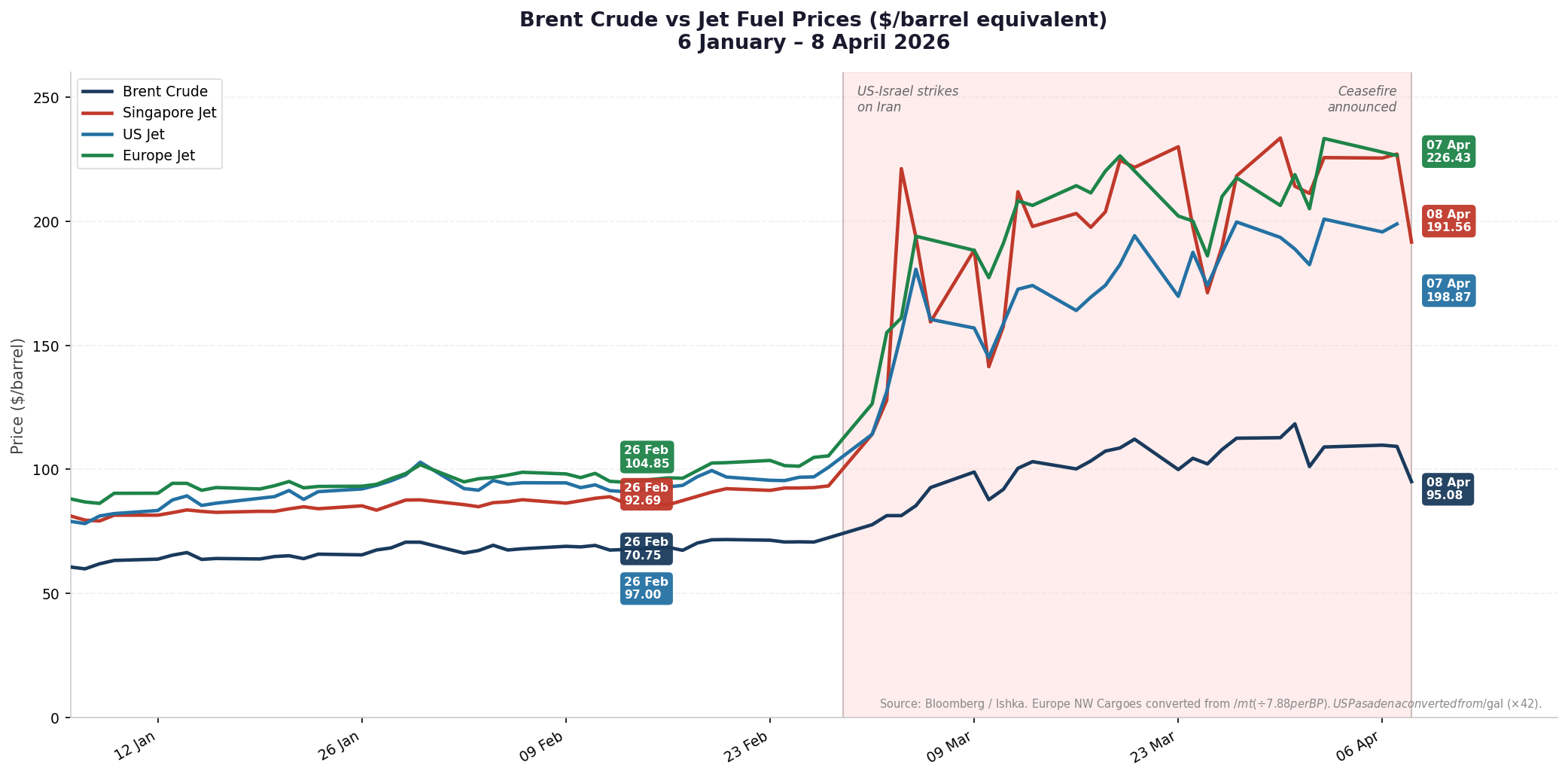
Brent crude dropped by nearly 15% following President Donald Trump's announcement of a conditional two-week ceasefire, though prices remain above pre-conflict levels.
However, Alan Gelder, SVP Refining, Chemicals & Oil Markets at Wood Mackenzie, warns that a return to pre-conflict conditions could take three to six months, even if the ceasefire holds.
"Many of the ships trapped in the Strait are still full, so they need to clear before empty vessels can return. Onshore storage has to be drained onto those ships before production can ramp up again," says Gelder.
"Refiners in the Middle East are still operating but at reduced rates, and restarting them will take time. Even if flows through the Strait resume in the coming weeks, inventories will need to be rebuilt, and supply chains reset.
“In practice, it could be towards the end of the summer before the system begins to look anything like pre-conflict levels."
Gelder describes the current conflict as “the biggest global energy shock that the world's gone through, apart from probably a World War,” describing it as around twice the severity of the 1970s Arab oil embargo.
In 1973, Arab members of OPEC retaliated against Western support for Israel by cutting output and banning exports to the US and its allies, removing around 4.5 million barrels per day from global markets and causing oil prices to quadruple. The current conflict has removed around five times that volume.
European airlines most at risk if jet fuel supply is disrupted
While the ceasefire offers some relief, the structural vulnerability of the European jet fuel supply will not be resolved overnight. Ryanair CEO Michael O'Leary told Sky News last week that there is a risk of supply disruptions in Europe by early May if the Strait of Hormuz does not fully reopen.
Any further disruption to fuel supplies would be felt most acutely by European airlines, which rely heavily on imports and have seen domestic refining capacity shrink in recent years.
In 2025, Europe imported more than half (54.3%) of its jet fuel and kerosene from the Middle East Gulf, according to Vortexa.
Since the conflict began, Gulf countries have cut total oil production by more than 10 million barrels a day, a reduction that will take months to unwind even as shipping resumes. Much of this crude would ordinarily travel to Asia as feedstock, where it is refined into jet fuel and exported to markets including Europe and the US West Coast.
"If this were just a disruption to jet fuel and diesel exports from the Middle East, you'd see a price premium in those products, but then the refining systems in the rest of the world would run harder to supply them," says Gelder.
"The issue here is we've effectively lost around 10 million barrels per day of crude and condensate. That means Asian refiners don't have the feedstock to run at full capacity, so the [jet fuel] exports Europe would normally rely on from Asia won't be there either. In some cases, Asian refiners may struggle to meet domestic demand as well."
Concerns over supply have already led China, Thailand, and South Korea to curb refined-product exports, including jet fuel. The Civil Aviation Authority of Vietnam warned airlines earlier this month to prepare for possible flight reductions, especially on domestic routes, due to the risk of jet fuel shortages.
By contrast, the US is better positioned than Europe and Asia. As the world's largest oil producer, it generates enough jet fuel to meet the vast majority of its domestic demand.
California is a notable exception. Stricter regulations and higher costs have shrunk refining capacity in the state, leaving it increasingly reliant on jet fuel imports from Asia.
The US decision to ease sanctions on Russian oil adds a further threat to European jet fuel supply. EU rules bar the import of any refined product made from Russian crude, irrespective of where it is processed. Lifting sanctions increases the pool of buyers for Russian crude, drawing Indian refiners away from products that Europe could otherwise import, according to Gelder.
Soaring prices squeeze airline margins
Source: Bloomberg and Ishka research
Supply concerns aside, the price shock alone has already threatened airline margins.
In response to more expensive jet fuel, Cathay Pacific has nearly doubled its fuel surcharge, while Qantas and Air New Zealand have raised fares. In Europe, Scandinavian Airlines has cancelled 1,000 flights this month while Lufthansa has drawn up crisis plans that could see as many as 40 aircraft grounded if prices remain elevated.
US carriers have also begun passing costs on to passengers. Delta Air Lines this week said it will raise checked baggage fees on select routes, following similar moves by United Airlines and JetBlue Airways.
The jet fuel crack spread, the premium of jet fuel over crude, increased to nearly $80 per barrel globally last week, around 275% higher than a year ago, according to the IATA-Platts Jet Fuel Price Monitor. In both Europe and Asia, jet fuel is currently trading at around $200 per barrel.
Fuel accounts for 25-30% of airline operating costs. If jet fuel prices remain above $200 per barrel, many carriers face negative or near-zero margins, which may force capacity cuts, downward revisions to earnings guidance, and, in some cases, aircraft groundings.
Last week, Ishka reported that ACMI provider Avion Express was returning at least 15 aircraft due to the “current geopolitical environment” (see Insight).
The US has so far been insulated from the worst of the jet fuel price spike, but that is beginning to change.
“We saw jet fuel cargoes leaving the US East Coast for Europe last week because the price spread was so wide,” says Gelder.
“That will push US jet fuel prices up towards European levels. In effect, the two markets are chasing each other.”
The Ishka View
A ceasefire is welcome news for airlines, but it does little to resolve the underlying strain in jet fuel markets. Soaring fuel costs have already placed pressure on carriers, and even well-hedged airlines were beginning to raise concerns over potential supply constraints heading into the summer.
Jet fuel prices are expected to remain elevated for several months. Vessels trapped in the Strait will take weeks to clear, while the uncertain nature of the ceasefire, described by US Vice President JD Vance as a “fragile truce,” is likely to deter a full and immediate resumption of shipping activity.
One commodity analyst told Ishka it remains unclear whether the ceasefire will hold, raising doubts over how quickly shipping companies will be willing to return vessels to the Strait without a more permanent resolution.
The Strait has also taken on greater geopolitical significance. Closing it would have been considered economic suicide for Iran a year ago, yet it has remained blocked for over a month, a strategy that has seemingly been vindicated. A further question is whether Iran will seek to preserve its newfound leverage over the Strait even after any US withdrawal, using it to deter future attacks.
Airlines can feel buoyed by news of the ceasefire. However, the future of the Strait, and with it the stability of global jet fuel supply, remains uncertain.




Sign in to post a comment. If you don't have an account register here.