


Quick Take: Gulf airspaces shut amid Middle East conflict
Listen to the article

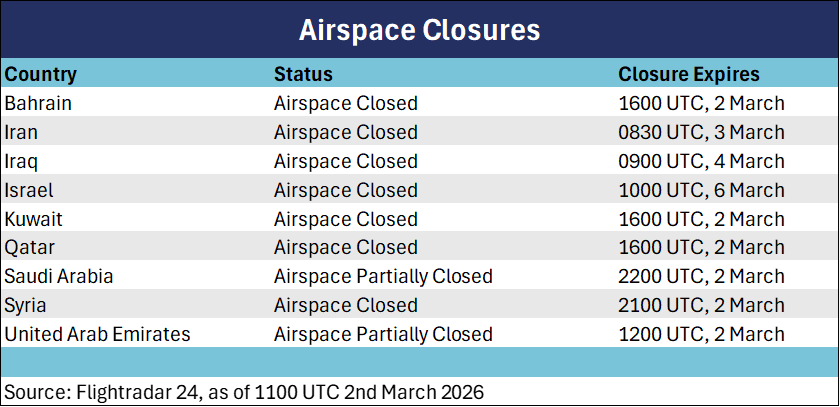
Extensive airspace closures across the Middle East have followed the US/Israel military strikes on Iran, forcing widespread disruption to regional air traffic. Several countries, including Iran, Iraq, Qatar, Bahrain, and Kuwait, have restricted or closed their airspace in response to the escalating conflict.
Iran responded with its own missile and drone strikes, targeting US bases and Gulf partners, with the UAE, Qatar, Kuwait, Bahrain, Saudi Arabia and Jordan reporting being hit or targeted.
Early this morning, the conflict spread to Lebanon, where Israel said it had launched strikes on Hezbollah targets.
The closures affect airspace across the UAE, Qatar, Saudi Arabia and several neighbouring states, forcing carriers to suspend operations and reroute flights through key Gulf corridors.
EASA issues conflict zone warnings
The European Union Aviation Safety Agency (EASA) has issued multiple Conflict Zone Information Bulletins advising operators not to conduct operations in high-risk airspace due to ongoing military activity.
The affected airspaces include Bahrain, Iran, Iraq, Israel, Jordan, Kuwait, Lebanon, Oman, Qatar, the United Arab Emirates, Syria, Yemen and Saudi Arabia.
EASA has extended the validity of the advisory until 6th March 2026.
In Europe, a Cypriot government spokesperson said two unmanned aerial vehicles bound for an RAF base in Cyprus were intercepted, prompting easyJet and British Airways to cancel flights to the island until Tuesday, 3rd March.
Gulf carriers suspend operations
Major carriers have announced temporary suspensions:
- Emirates has suspended operations to and from Dubai until 15:00 (UAE time), 3rd March.
- Etihad Airways has suspended flights to and from Abu Dhabi until 14:00, 3rd March.
- Qatar Airways has temporarily suspended all flights to and from Doha following the closure of Qatari airspace.
- Saudia has cancelled flights to and from Amman, Kuwait, Dubai, Abu Dhabi, Doha, Bahrain, Moscow and Peshawar until 2nd March at 23:59 GMT.
- flydubai has temporarily suspended all flights to and from Dubai until 15:00 (UAE time) on Tuesday, 03 March 2026.
Despite the airline’s website advising that all flights on Monday remain suspended, data from Flightradar24 indicates that Etihad Airways appears to have resumed several services, including flights to Amsterdam, Paris, London Heathrow Airport and Moscow.
Dubai Airports said a gradual restart of operations is expected this evening. However, activity will initially be restricted to a small number of flights at Dubai International and Al Maktoum International.
This is a developing situation. Reporting is based on information available as of 2nd March, 2026, 17:00 GMT.
The Ishka View
At this early stage, it is difficult to confidently forecast the conflict’s potential trajectory. President Trump told the New York Times that the US and Israel could continue “Operation Epic Fury” for another “four to five weeks”.
Iran’s retaliatory measures have already disrupted regional aviation, with airports reporting damage and most Middle Eastern carriers temporarily suspending or cancelling flights, issuing rolling 24-hour notices to passengers. Limited resumptions are expected in the coming days.
Eddy Pieniazek, Head of Ishka Advisory, believes the disruption could be short-lived, with a gradual return of operations. He notes that the Gulf remains the logical transit location for Europe–Asia air traffic, “particularly while Russian airspace remains restricted, while Africa currently lacks a comparable hub infrastructure.”
Depending on the duration of the disruption, the large three Gulf carriers may have to incentivise traffic and tourism to resume again as normal, which could be done “relatively quickly through competitive fare structures.”
One thing Ishka is monitoring, along with most airlines, is the potential impact on oil prices. There have been reports that at least three vessels were attacked near the Strait of Hormuz. The risk of further strikes could see oil prices remain elevated.
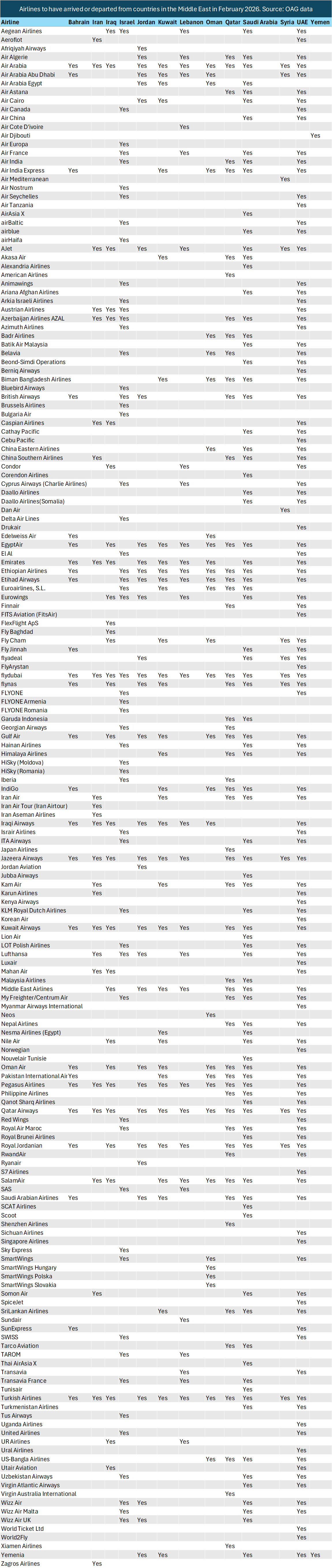
Which carriers are impacted?




Sign in to post a comment. If you don't have an account register here.